How to play
The Royal Game of Ur
A race for two on a board of twenty squares, from the Royal Cemetery at Ur, and a clear line between what was found, what a later tablet says, and the rules you can play tonight.
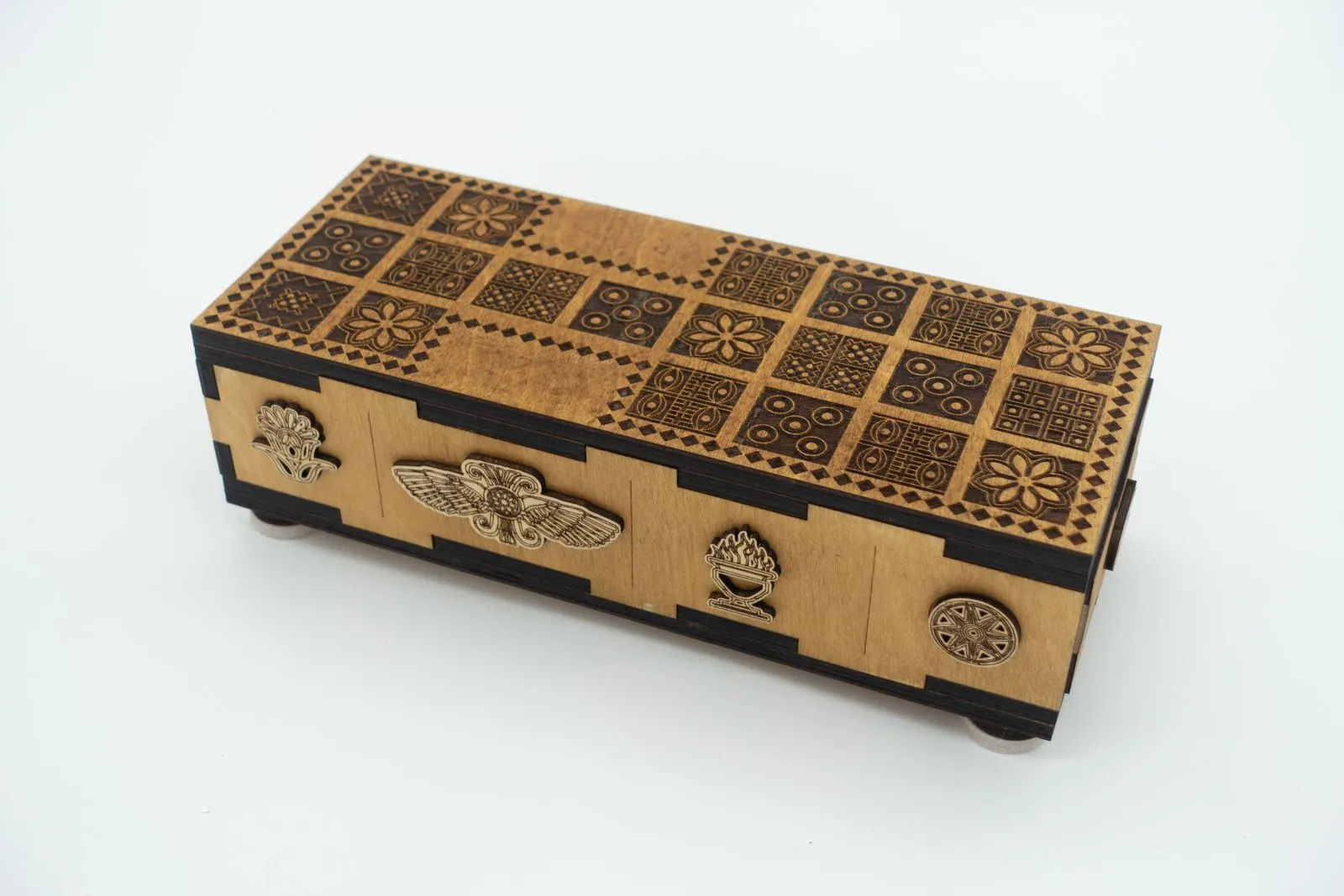
What it is
The Royal Game of Ur is the name that stuck to a race played on twenty squares. For study, Irving Finkel prefers the plainer label: the Game of Twenty Squares. The shape is easy to recognize. A block of four by three squares is joined to a block of two by three by a bridge of two squares.
Sir Leonard Woolley found the best-known examples in the Royal Cemetery at Ur, in southern Iraq, during the joint British Museum and University of Pennsylvania excavations of the 1920s. The board in the British Museum, museum number 120834 (registration 1928,1009.378; excavation number U.9000), is Early Dynastic III, 2600–2400 BC, and was made in Iraq. The museum lists it as wood and shell. It was a hollow box with a drawer, not a solid slab. The top carries twenty square shell plaques, some of them rosettes. Woolley’s own account, quoted on the museum’s object page, describes lifting it square by square under hot wax, and mentions lapis strips and red and blue spots set into the shell. The curator’s comment notes that the box originally held the pieces and the dice.
The British Museum gives the size as 2.40 cm high, 30.10 cm long, and 11 cm across the wide end, narrowing to 5.70 cm. It is on display in Room 56 (Mesopotamia, 6000–1500 BC), case 16. The same comment says the board was consolidated in the field and was not taken to pieces and remade then. In 1961 the museum’s conservator I. G. Tremayne repaired sagging caused by heat in the gallery. Other boxed sets from the cemetery are in the Iraq Museum in Baghdad.
Woolley published the cemetery boards in Ur Excavations II, The Royal Cemetery (1934). Finkel cites pages 275–279 and plate 95. The museum’s bibliography points to page 276 and plate 95b.
Finkel describes the third-millennium game as two players with seven identical pieces each. The dice found with these games were tetrahedrons, or four-sided stick dice. The tetrahedrons from Ur are stone or lapis lazuli. They are often called pyramids, which is the wrong shape: each has four flat sides and slightly rounded corners, and two corners marked with inlaid points. A single die scores when a marked corner lands uppermost, two chances out of four. Dice of that tetrahedral kind do not turn up in later Mesopotamian archaeology. Ten stick dice, numbered one to four, were also found at Ur (Woolley 1934, plates 99 and 221).
Boards of this type become common through the second and first millennia BC. Finkel counts more than a hundred examples, from Iraq, Iran, Israel, Syria, Jordan, Lebanon, Turkey, Cyprus, Egypt, and Crete. Early in the second millennium the narrow block was straightened into a continuation of the bridge, so the middle run became twelve squares. The board still had twenty squares. After about 2000 BC there is a tendency to drop the marked squares in the corners. A near-contemporary wooden board, not the inlaid Ur type, comes from the cemetery at Shahr-i Sokhta in Seistan, Iran. The British Museum’s curator comment also notes inlaid boards from Gonur-depe in Turkmenistan, and the view that the origins of these boards lie in the Indus valley.
What we know, and what is a modern reconstruction
Two different things get called “the rules.”
The only ancient writing of a rule set is a clay tablet in the British Museum, museum number 33333,b (registration Rm III, 6.b). The scribe Itti-Marduk-balātu finished it in Babylon on 3 November 177/176 BC. He was a trained member of a scribal family descended from Mušezib, and he copied a tablet associated with a scholar named Iddin-Bēl. The museum dates the tablet to the reign of Seleucus IV and, in the curator’s comment, to 177 BC. It lists Hormuzd Rassam as the excavator. Finkel writes that the tablet was turned up around AD 1880 and purchased by the museum from a dealer. It is displayed in the same gallery case as the Ur board.
For a long time the tablet was misread. Finkel notes that T. G. Pinches catalogued it among omens in 1886. Ernst Weidner, in 1956, took it for a book of lots. Benno Landsberger showed in 1960 that this tablet, and an earlier related one published by Jean Bottéro in 1956, concern a game. Finkel’s reading, published in 2007, is that the text gives rules for a board game and also records a fortune-telling use of part of the grid. The British Museum’s curator calls it the world’s oldest known rules for a board game, recorded by a Babylonian astronomer in 177 BC, and says that by then the game was played for bets with five different pieces per player. The front of the tablet shows the central squares used for fortune-telling.
That tablet is not a transcript of the seven-piece race. In Finkel’s translation the players use five different pieces, named as birds: a swallow, a storm-bird, a raven, a rooster, and an eagle. Some of those names are restored. Each player throws two knucklebones, an ox astragal and a sheep astragal, not tetrahedral dice. The throws 2, 5, 6, 7, and 10 are the ones that put those pieces on the board. Landing later on a rosette, or missing it, is tied to a bet and an omen: in his translation, success or failure with women, food, beer, or meat, depending on the piece. He reads the underlying game as a race and a betting game together, on the twenty-square board. The tablet does not draw the route. In the 2017 British Museum film with Tom Scott, Finkel says the tablet explains a complicated late version of a game people already knew, with betting, and that it leaves the route out because players knew it.
The way this page teaches you to play is the simple race, which Finkel calls stripped down to the bare minimum. It uses the seven pieces and the tetrahedral dice of the early finds, the marked squares, and a route inferred from the shape of the board. He says in that film that anyone who has played a game like Ludo can see how the path has to run, and that the assumption produces a friendly race. It is an assumption. Tim Kendall had already sketched the same kind of path, in a 1982 essay on games that Finkel quotes as the most plausible view then available: each player enters on their own short row of four, moves out along the middle in the other direction, and races off, with the marked squares as safe havens and a fight for the middle.
The rules below are that reconstruction. They are not a translation of the 177 BC tablet, and they are not a claim about a particular afternoon in the Royal Cemetery. Where a detail is only a modern habit, it is labeled as one. A British Museum blog post of 26 February 2021 puts the story more simply, and says Finkel deciphered the rules from the tablet as a race from end to end. Read that post with his 2007 chapter. The tablet and the race are not the same text.
What you need
- The twenty-square board, wide block at one end, narrow block at the other, bridge between them.
- Seven pieces per player. One player’s pieces are identical to each other. The two sets have to be easy to tell apart.
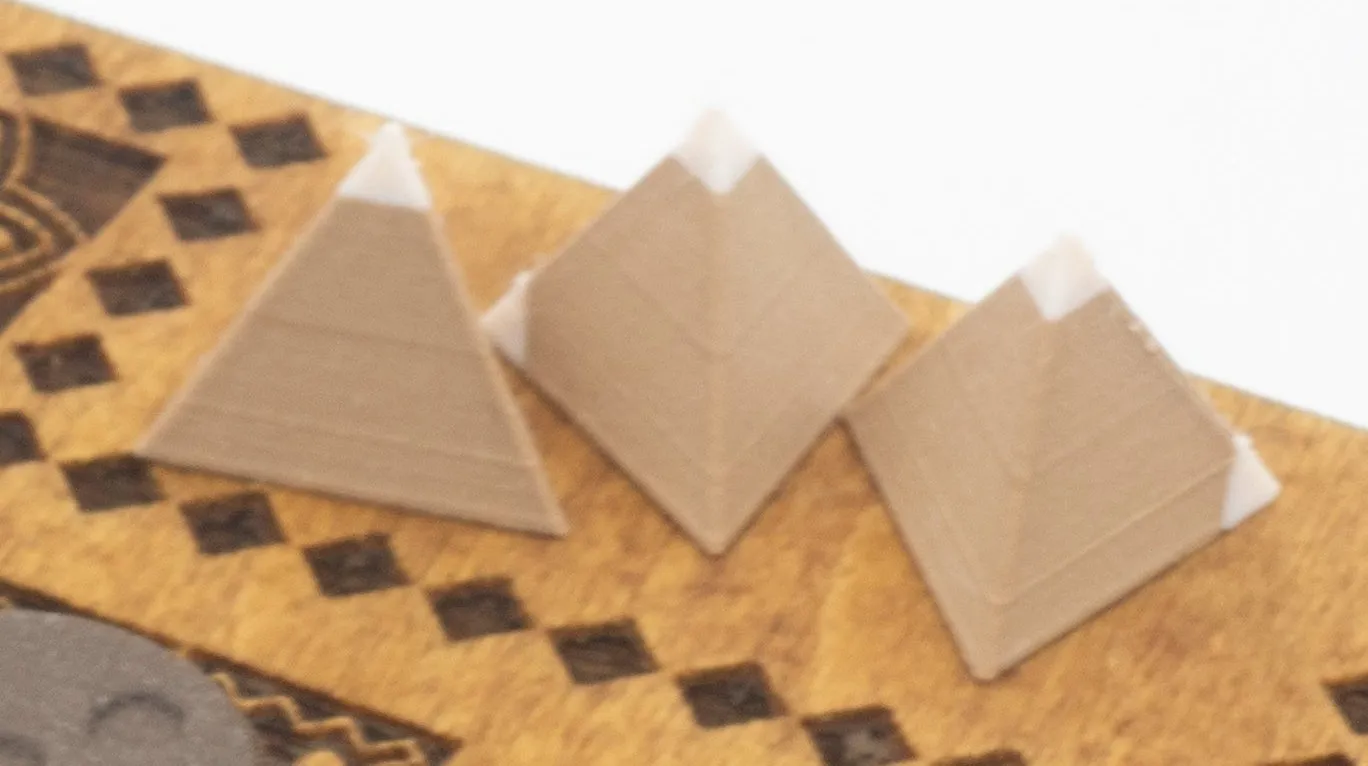
- Four tetrahedral dice. Each die has two of its four corners marked. If you do not have tetrahedrons, four coins are a fair stand-in: heads counts as a marked corner. A normal cube die is a different game.
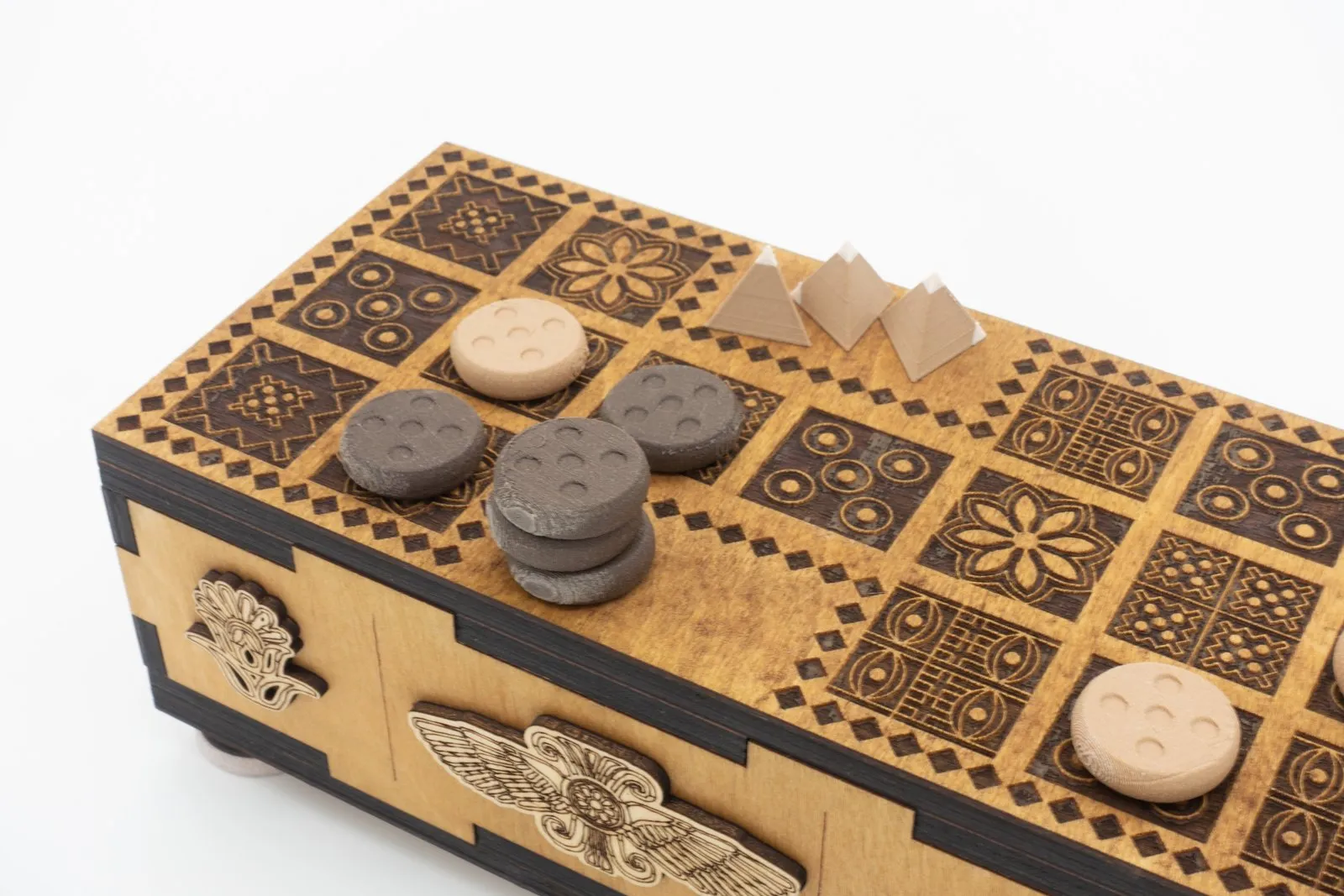
Throw all four together. Count the marked corners that land up. You get 0, 1, 2, 3, or 4, and that whole number moves one piece. In the film, Finkel tells his opponent not to split the throw. A throw of 0 loses the turn: four dice, no white mark, and you do not move.
If each marked corner is as likely as each blank, the odds are the odds of four coin flips. A 0 or a 4 comes up 1 time in 16, a 1 or a 3 comes up 4 times in 16, and a 2 comes up 6 times in 16. Finkel agrees with that comparison in the film. The arithmetic describes the dice. It is not an ancient scoring table.
The board and the route
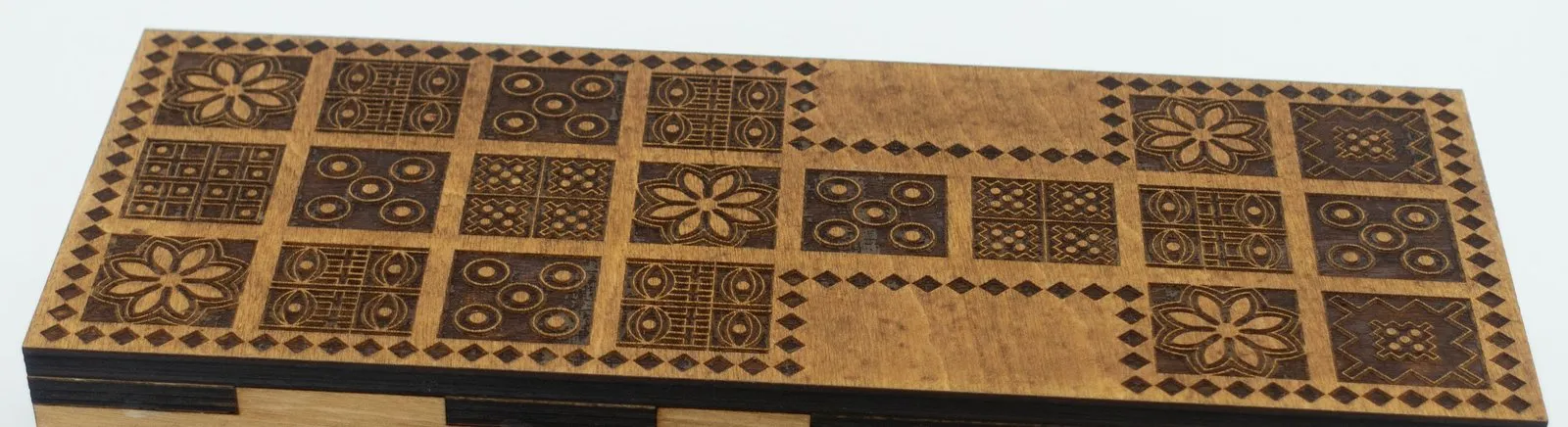
The photograph and the drawing are the Ancient Origins board, with the wide block on the left. Twenty squares: four columns of three, a bridge of two squares in the middle row, and a narrow block of two columns. The wood above and below the bridge is a plain panel. It is not a square, and you do not play on it.
Five squares are eight-petal flowers. On the route below, those flowers are square 4, square 8, and square 14. Square 4 is the outer corner of your wide-block row. Square 8 is the middle square just before the bridge, and it is the one both players can land on. Square 14 is the narrow-block square beside the plain panel. The outer corners of the narrow block are stepped stars. On this route the star is square 13, and it is not a rosette.
The other squares carry the motifs engraved on this board: eyes, five ring-and-dot circles, dotted panels, and one dotted grid. They mark the square. They do not change the move. The line is one continuous path of fourteen squares for the player sitting at the bottom. It steps only from a square to a square that touches it. It is the reconstruction used on this page, not a path copied off the tablet.
- You enter at the square of your own row nearest the bridge, the fourth square from the left end of that row. Squares 1–4 then run outward, and square 4 is the corner flower.
- Squares 5–12 run the whole middle row from left to right. Square 8 is the flower. Squares 9 and 10 are the bridge.
- Squares 13 and 14 are your two squares on the narrow block. From square 12 you step onto the outer star, square 13, then inward onto the flower, square 14. You bear off from that flower.
The other player uses the top row as a mirror and shares the middle, traveling it in the same direction. Squares 1–4 and 13–14 are private. The opponent never lands on them. Squares 5–12 are the only squares where a capture can happen. In the film Finkel calls that shared run the place where the two of you are at war: land on the other player’s piece and it comes off to start again.
On a small screen, swipe the board sideways. The narrow end is on the right.
Video coming soon. A film of this set, in the owner’s own words, will go here. Until then, the British Museum’s 2017 demonstration with Tom Scott and Irving Finkel is the film these rules follow: Tom Scott vs Irving Finkel: The Royal Game of Ur.
Setup
- Empty the board. All fourteen pieces start off it. Any number of your pieces may wait off the board at once, including pieces that have been captured.
- Sit so that one player owns the lower row and the other owns the upper row. Either end of the board may be nearer you. Agree before the first throw.
- Pieces enter on square 1 of their own route. There is no separate “on” throw. A throw of 1 from off the board lands on square 1. A throw of 4 from off the board lands on square 4, the first rosette, and you throw again.
The film does not legislate who throws first. Decide however you like. A common modern habit is to let both players throw, give the opening to the higher total, throw again on a tie, and let the opening player throw once more for the first move. That convention is not in the tablet and not in Woolley’s report. Label it as a way to start, not as an ancient rule.
A turn, step by step
- Throw the four dice. Throw all four tetrahedrons at once, or four coins if that is your stand-in.
- Count the marks. Count how many marked corners land up. The total is 0, 1, 2, 3, or 4. That whole number moves a single piece. Do not split it.
- A throw of 0 ends the turn. If nothing is marked, you do not move. The turn passes.
- Move one piece forward. Move one of your pieces exactly that many squares along your route, forward only. From off the board, a throw of 1 lands on square 1, a throw of 2 on square 2, and so on, if that square is free.
- Pass only when nothing is legal. If any legal move exists, take one. You may not land on your own piece. You may jump over any piece. If every option is blocked, the turn passes.
- Capture only on the shared middle. Squares 5 through 12 are shared. If you land on an opponent’s piece there, and it is not sitting on the rosette, that piece leaves the board and starts again. You do not have to capture when another legal move exists.
- Rosettes give another throw. If the move ends on a rosette (squares 4, 8, or 14 on this route), throw again. A piece on a rosette cannot be captured. An opponent may jump it and may not land on it.
- Bear off with an exact count. A piece leaves the board only on an exact throw. From square 14 you need 1. From 13 you need 2. From 12 you need 3. From 11 you need 4. The first player to bear off all seven pieces wins.
Moving and capturing
You always move forward along your own numbers. You cannot land on a square you already occupy. You can jump your own pieces and your opponent’s.
Capture happens in one case only. The square you land on is one of 5 through 12, an opponent’s piece is already there, and that square is not a rosette. Their piece is removed and returns to the start, off the board. Your piece stays where it landed. If that square is square 8, you cannot land there while they occupy it, because a rosette is safe. You also cannot capture on 1–4 or 13–14, because those squares are not on your opponent’s route.
Suppose you throw a 2, you have a piece on square 7, and the opponent has a piece on square 9. You may move from 7 to 9 and send that piece off. You may instead enter a new piece, or move a different piece, if that move is legal. Nothing in this reconstruction forces the capture.
A throw you cannot use is not saved. If the only pieces you could move are blocked, or the count would carry a piece past the end without landing exactly off, and no other piece can take the throw, you pass.
Rosettes
In this reconstruction a rosette does two things, which is how Finkel states it in the film. Landing on it gives you another throw. While you sit on it, no one can land on you or knock you off. They can jump you.
On the route drawn here, the rosettes a player actually reaches are squares 4, 8, and 14. Squares 4 and 14 are private, so an opponent was never going to capture there. Their extra effect is the extra throw. Square 8, the central flower, is the one that changes a fight: it is safe in a row that is otherwise hostile. Square 13 is the star on the outer corner of the narrow block. Landing there does not earn another throw.
The 177 BC tablet uses rosette squares differently. In Finkel’s translation, whether a piece then lands on a rosette decides a bet: women and well-being for the swallow, food for the storm-bird and the raven, beer for the rooster, meat for the eagle. That scheme belongs to the late betting game. It is not an extra rule of the race on this page. Finkel also notes a Babylonian word-list term he translates “lucky” for a class of piece, literally a goddess’s name. That is vocabulary, not a rule that every flower on the Ur board is a particular deity.
Winning
Get all seven of your pieces off the end of the path before your opponent does. Bearing off takes an exact count, the same idea as the last square in the film, where a piece on the final square needs a 1.
- On square 14, the flower, only a 1 bears off. The throw that landed you there already earned another throw.
- On square 13, the star, a 1 moves to 14 and a 2 bears off. Square 13 is not a rosette.
- On square 12, a 3 bears off. On square 11, a 4 bears off. A larger count cannot be used for that piece.
You may bring a new piece on, or move something still in the middle, instead of bearing off, when that other move is legal. The first player with no pieces left on or off the board, all seven borne off, wins.
Common variants
Everything in this list is either the separate ancient game or a modern house rule. None of it is a silent extra in the race above.
The tablet’s game
Five different bird pieces, two astragals, named entry throws of 2, 5, 6, 7, and 10, bets on the rosettes, and a fortune-telling use of the twelve central squares. That is the historical game on BM 33333,b, as Finkel reads it. This page does not expand it into a full move-by-move ruleset. Several lines are uncertain, and the text assumes a route it never spells out.
A blank counts as four
Some modern sheets treat a throw with no marks as 4, often with three dice rather than four. Finkel’s demonstrated game treats an unmarked throw as a lost turn. If you play the blank as 4, say so before you start.
Fewer pieces
A shorter game with fewer than seven pieces a side is a modern shortcut. The third-millennium game Finkel describes uses seven identical pieces. The tablet uses five, each different. Do not treat a shorter game as a third ancient count.
A longer path, and rosettes that are not safe
Some modern rules lengthen the route so that a marked square falls on every fourth step, and send the two paths across each other at the far end. In those versions a rosette often does not protect a piece. They are proposals about how the board might have worked, not the race demonstrated in the film, and not the tablet.
Five-piece tournament rules
Current match rules sometimes use five pieces, allow more than one piece on a rosette, or give an extra throw for a capture. Treat those as separate modern games.
FAQ
Is this exactly how the game was played in 2600 BC?
No one can show that. The boards, the seven pieces, and the tetrahedral dice are ancient. The only written rules turn up in 177/176 BC, and they describe a later betting game with five different pieces. The race on this page is a modern reconstruction in the family of the simple game Irving Finkel demonstrates.
What does a throw of 0 mean?
In the reconstruction taught here, the turn ends and you do not move. That is how Finkel plays it in the 2017 British Museum film: four dice with no marked corner up, and the turn is lost. Some modern sheets count a blank as 4 instead. That is a different rule.
Can I use coins instead of tetrahedral dice?
Yes, as a modern stand-in. Four coins, with heads as a marked corner, give the same totals from 0 to 4. A cube die does not. In the film, Finkel agrees that the tetrahedrons behave like four coin flips.
How many pieces does each player have?
Seven identical pieces in the third-millennium game Finkel describes, and in this reconstruction. The two sides have to be easy to tell apart. The 177 BC tablet uses five pieces, each one different, named in his translation as birds.
Are the rosettes safe?
In this reconstruction, yes. A piece on a rosette cannot be captured, and landing on one earns another throw. You may jump a piece on a rosette, but you may not land on it. On this diagram only square 8, the central flower, is a rosette an opponent can reach. Squares 4 and 14 are already on your private row. Square 13 is a star, not a rosette.
Do I have to use the whole throw on one piece?
Yes. The count is not split across pieces. Finkel plays it that way in the film.
Do I have to capture?
No. On the shared middle squares you may land on an opposing piece that is not on a rosette, and that piece goes back off the board. If another legal move exists, you may take it instead.
What is the difference between the tablet and this race?
The tablet is a late game, played for bets, with five different pieces and two knucklebones. It also uses part of the grid for fortune-telling. This page teaches a simple seven-piece race reconstructed from the earlier boards. The tablet does not write down the route.
Sources
- British Museum, game-board, museum number 120834, registration 1928,1009.378, excavation number U.9000. Collection online. Object record, description, dimensions, display location, and the curator’s comment quoting Woolley and noting the 1961 treatment by I. G. Tremayne.
- British Museum, clay tablet, museum number 33333,b, registration Rm III, 6.b. Collection online. Curator’s comment: rules for the game of twenty squares, 177 BC, five pieces, bets, and fortune-telling on the central squares. The page cites Bottéro, Weidner, and Finkel.
- C. Leonard Woolley, The Royal Cemetery, Ur Excavations 2 (London and Philadelphia, 1934). Finkel cites pp. 275–279 and plate 95; the British Museum bibliography cites p. 276 and plate 95b. Stick dice: plates 99 and 221, as cited by Finkel.
- Irving L. Finkel, “On the Rules for the Royal Game of Ur,” in Irving L. Finkel (ed.), Ancient Board Games in Perspective (London: British Museum Press, 2007), pp. 16–32. The date 3 November 177/176 BC, the scribe, the five bird pieces, the two astragals, the entry throws, the rosette wagers, seven pieces and tetrahedral dice at Ur, the board’s shape, and the quotation from Kendall.
- Andrea Becker, “The Royal Game of Ur,” in the same volume. Finkel points to it for the Ur boards, and the British Museum bibliography lists the chapter. Page numbers are not repeated here.
- T. Kendall, “Games,” in Egypt’s Golden Age: The Art of Living in the New Kingdom, 1558–1085 B.C., exhibition catalogue, Museum of Fine Arts (Boston, 1982), pp. 263–272. Quoted and discussed in Finkel 2007, p. 17.
- T. G. Pinches, Guide to the Nimroud Central Saloon (London, 1886), p. 71, no. 33, as cited by Finkel for the omen cataloguing. Jean Bottéro, “Deux curiosités assyriologiques,” Syria 33 (1956): 17–35. Ernst Weidner, “Ein Losbuch in Keilschrift aus der Seleukidenzeit,” Syria 33 (1956): 175–183. Benno Landsberger, “Einige unerkannt gebliebene oder verkannte Nomina des Akkadischen,” Wiener Zeitschrift für die Kunde des Morgenlandes 56 (1960): 109–129.
- British Museum, “Top 10 historical board games,” 26 February 2021. Blog post. A short public account. It compresses the tablet and the race into one set of rules. The film it points to is the demonstration used on this page.
- British Museum and Tom Scott, “Tom Scott vs Irving Finkel: The Royal Game of Ur” (2017). Video. Source for the simple race as played: seven pieces, four tetrahedrons, no split throw, a blank loses the turn, the middle as the place of capture, rosettes safe and worth another throw, and an exact throw to bear off.